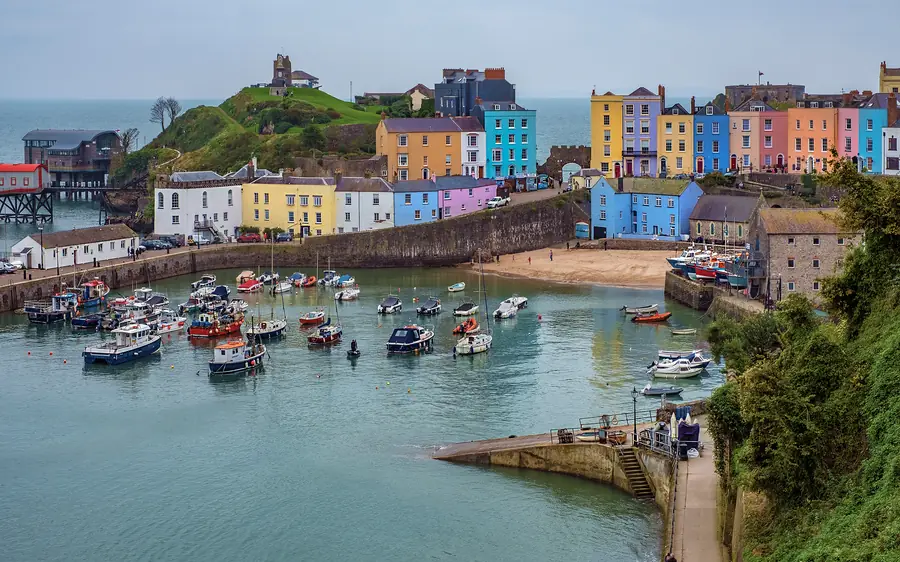
Tenby is one of the few Welsh resorts where leaving the car at home is a plan rather than a dare. The station is a few minutes from the walls. The four beaches sit under the same headland. Caldey is a boat, not a drive. The branch line already goes to the castles people hire a car for.
This is the car-free stay. The parking article is the other one.
Arrive on the Pembroke Dock branch. Walk to the harbour, Castle Beach, South Beach and Tenby Castle. Use the train for Pembroke and Manorbier. Use the boat for Caldey. Do not try to do St Govan’s, Folly Farm and Stackpole on the same day without looking at a timetable first. Frequencies change; National Rail and Traveline Cymru are the documents to trust, not a paragraph in a guide.
Tenby sits on the Pembroke Dock branch of the West Wales Line, managed by Transport for Wales. East, the trains run to Saundersfoot, Kilgetty, Narberth, Whitland, Carmarthen and on toward Swansea. West, they run to Penally, Manorbier, Lamphey, Pembroke and Pembroke Dock. Tenby is the passing loop on the branch, which is why you can sit in the station and watch two trains occupy the same town.
The advertised shape is roughly every two hours each way, with extra peak services and a thinner Sunday. Some early and late trains start or finish at Carmarthen rather than Swansea. On summer Saturdays Great Western Railway has run through trains from London Paddington; the rest of the year you change, usually at Swansea or Carmarthen. Check the day you travel. Our getting here page has the Pembroke Dock branch into Tenby station.
The station is unstaffed, about four minutes’ walk from the centre on the council’s own figure, slightly more with a bag. Out of the forecourt you are already on the plateau the walls sit on. You do not need a bus into town. APCOA run the Tenby station car park if someone is meeting the Pembroke Dock train; you do not need it.
Coming from the north or east, Carmarthen is the useful interchange. Coming from Pembroke Dock after a castle day, you are already on the right line.
This is the argument for not bringing a car.
From the station to Tudor Square is a short walk. From Tudor Square to the Five Arches, the harbour, Castle Hill and the top of the beach steps is another. The old town is a walled plateau you can cross in ten minutes. Our town walls piece is that circuit.
Hills are the catch, and they are real. Tenby stands above its water. Every beach is a descent: steps to North Beach and Castle Beach, a ramp at South Beach, harbour level for the small sand beside the boats. Luggage, buggies and anyone who does not want stairs need the South Beach ramp, the lift near the harbour, or a stay that does not involve carrying a windbreak down a cliff.
Once you are in the town, you do not need transport until you leave it. In summer the walled streets are pedestrianised through the middle of the day anyway. A car you then have to park is the problem the parking guide exists to solve.
All four are a few minutes from the walls. That is the whole trick.
South Beach is the long one — two kilometres toward Giltar Point, lifeguards in season, the gentlest access. Castle Beach is the cove under Castle Hill, with St Catherine’s Island walkable at low tide. North Beach is the curve below the pastel houses, with Goskar Rock on the sand. Harbour Beach is the pocket beside the boats.
Which you use depends on the tide and the wind, not on a car park. At low water they join. At high water North and Harbour shrink or vanish. Get a tide table. Our beaches guide is the operational document; this page is only saying you walk to all of them.
A land train runs along the seafront in season. It is a help with tired children and a steep town, not a substitute for the walk. The coast path north to Saundersfoot is five kilometres, about ninety minutes, with a train back from Saundersfoot station. South to Penally and Giltar is on foot, with the range-firing caveat on the far side of the golf links. The walks guide has the routes.
There is no car on the island that you can use, and no reason to want one.
Boats to Caldey leave from Tenby harbour at high tide and from Castle Beach at low tide. Twenty minutes. Seasonal — typically Easter to the end of October — Monday to Saturday, not Sundays, not in wind or swell. You walk to the kiosk from the town. You do not drive to it.
Check the operator, check the boarding point, and do not save the crossing for the last morning. Our Caldey guide is the rest. Our harbour piece is where you stand while you wait.
The island is the cleanest argument for a car-free week: the highlight of many stays is a boat you reach on foot from a station.
This is what the branch is for.
Pembroke Castle is a short walk from Pembroke station. The train from Tenby is about twenty-five to thirty minutes on a typical service. The castle is the big one in the county — the round keep, the gatehouse, the Wogan Cavern, Henry VII born there — and it is a full half day. You do not need a car for it.
Manorbier Castle sits above a beach, seven kilometres south-west of Tenby as the road goes, and a few minutes further down the same line. The station is a walk from the castle and the sand, not a drop at the gate — allow time, and do not treat it as a step-free arrival. Gerald of Wales was born in the castle and called it the pleasantest spot in Wales. The beach below is free.
Lamphey is the halt between them, for the bishop’s palace. Pembroke Dock is the end of the line. Penally is the first stop west, useful for the coast path and the village, with the range warning still in force on the cliffs beyond.
East, Saundersfoot is the train-back from the coast-path walk, and Narberth is the food town. Check the last return before you sit down to dinner. Sunday and winter shapes are thinner.
Carew Castle is not on the branch. Buses toward Pembroke and the Cleddau side exist; timetables move. Look it up the night before, or treat Carew as a different day with a different tool.
Town and county buses cover Saundersfoot, Amroth, Pembroke and Haverfordwest. Seasonal coastal services — the Coastal Cruiser and the Puffin Shuttle among them — pick up the coast path further west in summer. They are not a metro. School-day, Saturday and winter maps are not the same map. Traveline Cymru is the planner; contactless on the bus is normal.
What a car-free week does easily: the town, the four beaches, Castle Hill, Caldey, Pembroke, Manorbier, Saundersfoot, a wet day in the museum, the walls.
What it does with a timetable: Carew, Laugharne, Narberth, the National Botanic Garden via Carmarthen.
What walking and the branch do not do comfortably: St Govan’s Chapel and the Castlemartin cliffs, Barafundle and Stackpole, Folly Farm, Heatherton, the Dinosaur Park, Manor Wildlife Park, Picton Castle Gardens. Those are a bus-plus-walk you have checked, a taxi, or they are a car. Our kids guide and day trips are honest about that.
Do not invent a Sunday service to a dinosaur park. Look it up.
If you were wondering whether to hire one for a week:
St Govan’s when the range is open. Stackpole and Barafundle in one loop. Folly Farm with tired children and a buggy. Picton on a wet morning. A late table in Narberth after the last train. The Castlemartin coast at dusk.
What it is not for: South Beach, Castle Beach, the harbour, Tenby Castle, the Five Arches, a boat to Caldey, Pembroke keep, Manorbier on a falling tide. For those, the car is something you then have to park, in a town that pedestrianises its own streets and fills Battery Road by ten.
Come on the train. Walk down to the sand. Take the boat when the water allows. The when to visit page is the calendar. This page is the way in.