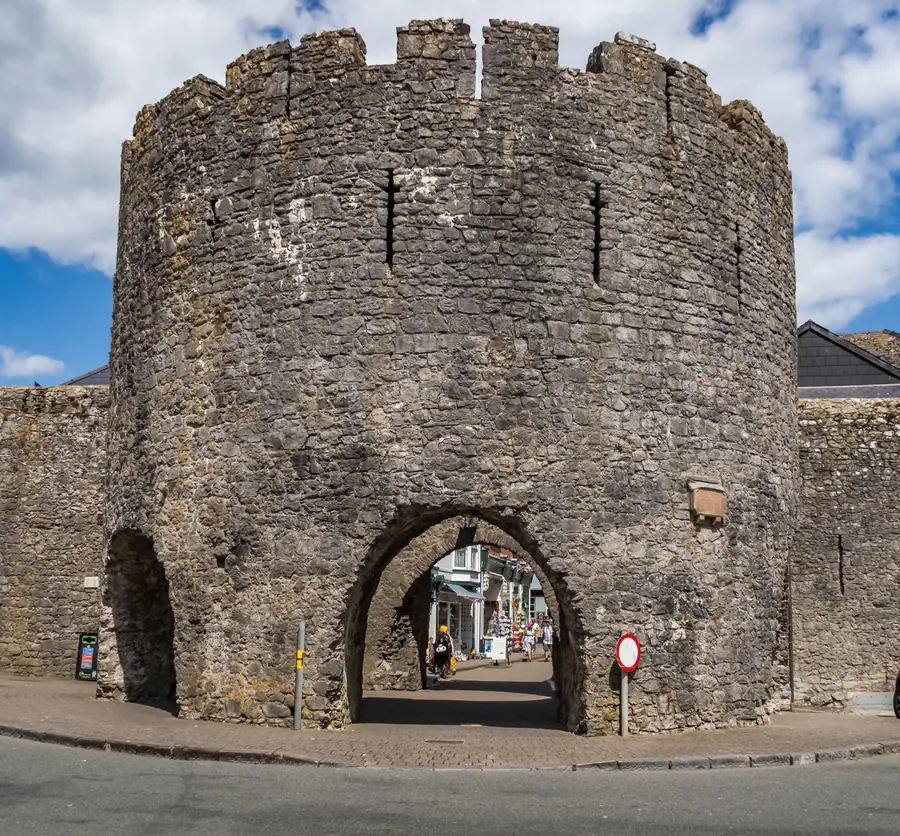
Tenby’s walls are the reason the town still looks like a town rather than a seafront. They enclose the old streets, they keep the cars out in summer, and the Five Arches on South Parade is the second most photographed structure in Pembrokeshire after the harbour. You can walk their line in an hour. It costs nothing.
This is not a castle article, and it is not a coast-path walk. Tenby Castle is a fragment on a different rock. The walks guide covers Saundersfoot and Giltar. What follows is the circuit of the walls, the gate, and the streets they still protect.
The stone you walk beside is mostly thirteenth and fifteenth century. An earthen bank and timber palisade came first, after Welsh forces burned the settlement in the late twelfth century. The Marshal earls of Pembroke began the stone circuit; William de Valence rebuilt it in earnest after Llywelyn ap Gruffudd sacked Tenby in 1260. By the early fourteenth century the walls had taken over from the castle as the town’s real defence.
In 1457 Jasper Tudor made the burgesses responsible for the walls and had them raised, thickened, and given a second tier of loops, with the landward moat widened. A tablet on the west wall records a later repair in 1588. Cadw lists the surviving circuit Grade I: one of the most important medieval town walls left in Britain.
There were four gates. The Great or Carmarthen Gate came down in 1781, the South Gate in 1797, the Quay Gate in 1811. Only the western barbican survives. That is the Five Arches.
There is no continuous wall-top walk as at Conwy. You walk the line at street level, looking up, going through, and using the stretches where a path still follows the outside.
The Five Arches is a D-shaped barbican on South Parade, built to defend the West Gate. A horseshoe of masonry stands in front of the original portal, with arrow loops covering the old moat. The name is later than the defence: extra arches were cut through the barbican in the modern period to move traffic. One passage is the medieval line; the others are the town making room.
It is free, always open, and the way most people enter the old town on foot. Stand on South Parade and look at it before you go through. The outside is the military object; the inside is a street.
In 1867 the town council wanted the barbican down. Historical societies and a court injunction stopped them. That is why you can still photograph it.
A small pay-and-display sits near the gate. It is not a parking plan. Park in the multi-storey on Upper Park Road, a few minutes up the hill, and walk. See parking in Tenby.
The best surviving run is the south-western curtain along South Parade and St Florence Parade: a long face of wall, towers, and the barbican, with the old town on one side and the later streets on the other. Six towers survive on this side. There may have been two dozen on the original circuit.
Walk it slowly. The loops, the change in masonry, the way the wall steps with the ground — this is the bit that earns the listing. Then go through the Arches into St George’s Street and the lanes.
North and east the circuit is more broken. The sea did some of the defending on those sides, which is why the harbour and Castle Beach sit under a cliff rather than under a wall. You pick the line up again toward the harbour and Castle Hill, where the town ends in a rock instead of a gate.
Allow an hour for the Parade, the gate, a loop through the streets, and a pause. Allow two if you go into St Mary’s and down Quay Hill.
Through the Arches you are in the medieval street plan: High Street, Tudor Square, St Julian’s Street, Upper and Lower Frog Street, Quay Hill down to the harbour. It is small. A brisk walk from the gate to the harbour is ten minutes. You will not be brisk.
St Mary’s is the largest parish church in Wales, free and open, with a fifteenth-century wagon roof and the tomb of Thomas White, the mayor who hid the fourteen-year-old Henry Tudor in 1471 and shipped him to France. The Tudor Merchant’s House on Quay Hill is National Trust, a late-fifteenth-century house over three floors, and the best surviving domestic building of its period in the town.
The rest is shops, galleries, pubs and the ordinary work of a small town that happens to be inside a wall. Because cars are kept out of the core in summer, it is actually pleasant to walk rather than merely pretty. Our eating guide is the lunch version of the same streets.
Do not treat it as a tick-list. The point of a walled town this size is that you can wander it between breakfast and a beach, and still have the afternoon.
Tenby Castle stands on a headland almost separated from the town, joined by a narrow isthmus, with North Beach one side and Castle Beach the other. It is a thirteenth-century fragment — a tower, some wall — and it was never the main defence once the town walls went up.
Walk it anyway. Ten minutes from Tudor Square. The view is the finest in Tenby: both beaches, the harbour, St Catherine’s Island, Caldey, the whole of Carmarthen Bay. The Prince Albert memorial is on the summit. The museum sits in the old castle grounds and charges; the hill is free.
The walls protected the town. The castle watched the harbour. Doing both in one morning is the right history lesson, and it is all on foot.
Every summer the walled town is mainly a vehicle-free zone through the middle of the day. In 2026 the council scheme ran 6 July to 11 September, 11am to 5.30pm. Dates move; the pedestrianisation page is current.
The core — High Street from Crackwell Street to Tudor Square, Tudor Square itself, Church Street, St Nicholas Lane — is traffic-free in those hours. Western and eastern streets have resident and business permits. Visitors park outside and walk in. That is not a defeat. It is why the Arches still feel like a gate rather than a roundabout.
Outside the scheme the streets are still narrow. Do not hunt a bay inside the walls in any month. The without a car piece is the other way to arrive: the station is a few minutes from South Parade.
The walls sit on the plateau. The beaches are at the bottom.
From the Arches, St George’s Street and the lanes drop toward the Esplanade and Castle Beach, or you go through the town and down from Castle Hill. The steps are steep. The ramp at South Beach is the pushchair route, on the other side of the headland.
Castle Beach is the one that belongs with this walk: the cove under the castle rock, St Catherine’s Island offshore, the harbour two minutes north. Time it on a falling tide if you want the island. Our beaches guide has the water; this page only needs you to know that the wall-walk and the sand are one outing, not two.
The walls, the Five Arches, the streets, Castle Hill, the harbour lookout and the beaches are all free. That is most of what people come to Tenby for. The free things list is the wider version; this walk is the hour at the centre of it.
You pay for the museum, the Merchant’s House, a Caldey ticket, and the car park you should have used on Upper Park Road. You do not pay to stand in the barbican.
Start on South Parade, outside, and look at the curtain and the towers before you go in. Through the Five Arches. St Mary’s if it is open. Tudor Square and the High Street, then Quay Hill to the harbour. Up onto Castle Hill for the view. Down to Castle Beach if the tide is dropping. Back through the lanes for food.
That is a medieval gate, a parish church, a working harbour and a castle fragment, in a loop you could do before lunch. The coast path can wait until the afternoon. The day trips can wait until tomorrow.
Do it early, or in September, or on a wet Tuesday in February when the Arches have no queue. The walls do not close. The streets just get full.