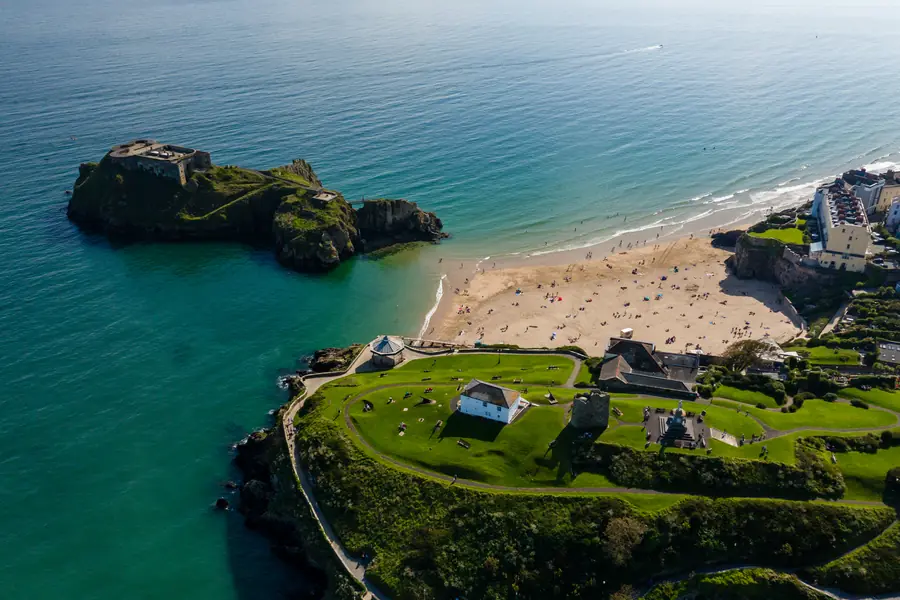
Castle Beach is the small sandy cove tucked under Castle Hill between the harbour and South Beach, and it is the most photographed piece of coast in Wales.
It has been named best beach in Britain in national awards, and while such things come and go, in this case the case is easy to make.
Three things are in the frame at once.
Castle Hill rises directly behind, with the ruined castle and the Prince Albert statue on top.
St Catherine’s Island sits immediately offshore — a rocky islet with a Victorian Palmerston fort of 1870 on it, built against a French invasion that never came. At low tide you can walk out to it across the sand.
The town — the pastel-painted Georgian houses on the cliff above the harbour — closes the view to the north.
There is nowhere else in Britain where a beach, a castle, a fort on an island and a walled town line up like that.
Sand, with rock and reef at the edges and good rock pools at low water.
It is small, and it shrinks substantially at high tide — at the top of a spring tide there is very little of it. Go at low or falling water.
The water is clean and clear and the cove is sheltered, which makes it good for swimming, snorkelling and paddling.
No lifeguards — the patrolled beaches in Tenby are North and South. That, plus the tide and the rocks, makes Castle Beach better for competent swimmers and supervised paddling than for children left to themselves.
The fort has opened to visitors intermittently over the years, under private ownership, and its status changes. Check locally if getting inside matters.
Walking out to the island across the sand at low tide is free and is the thing most people do.
Watch the tide. The causeway covers, and people are cut off there every season.
Limited on the beach itself. The harbour is two minutes away with cafés, the Caldey Island boats, and the run of the town above.
Steps and a slope lead down from Castle Hill and from the harbour.
Free, open at all times.
Access: steps and slopes down from Castle Hill or the harbour; not accessible.
Tide: the crucial factor. Low or falling water is when the beach is worth being on.
Lifeguards: none. North and South Beaches are patrolled.
Dogs: restricted in the main season — check the signs. South Beach has a dog-friendly section.
Parking: Tenby’s town car parks; the walled town is largely closed to traffic in season.
Tenby Castle and Castle Hill immediately above, free, with the best view in town and Tenby Museum.
The harbour, two minutes, with boats to Caldey Island — a Cistercian monastery island with beaches, a chocolate and perfume-making community and a fine walk, reached in twenty minutes by boat.
The Tudor Merchant’s House, National Trust, by the harbour.
North Beach on the other side of the headland.
It has won national awards for it. The setting — castle, island fort and walled town in one view — is what makes the case.
No. North and South Beaches in Tenby are patrolled; Castle Beach is not.
At low or falling tide. The beach shrinks substantially at high water.
Yes, across the sand at low tide. Watch the tide, because the causeway covers and people get cut off.
Restricted in the main season — check the signs. South Beach has a dog-friendly stretch.