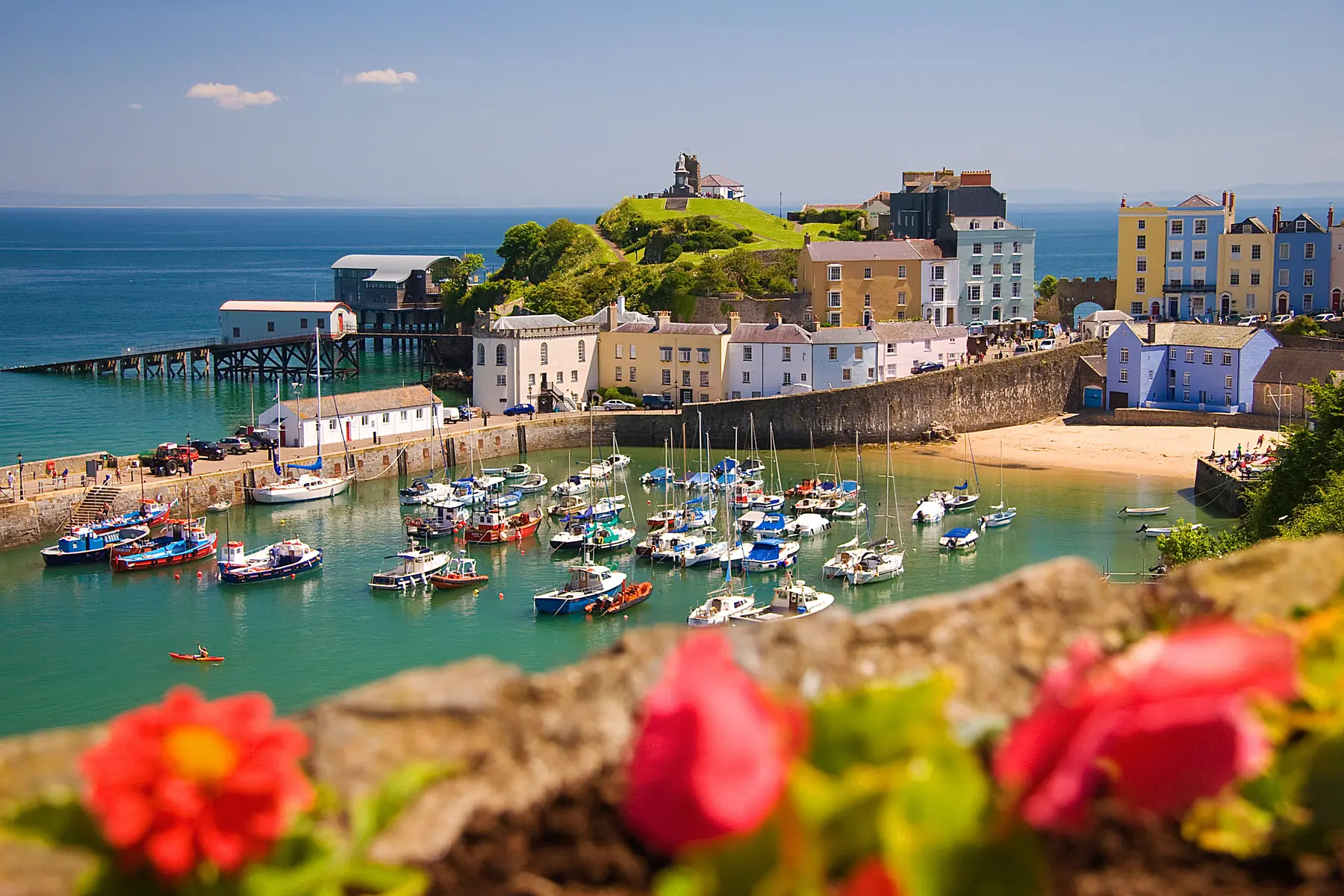
Tenby sits in the south-eastern corner of Pembrokeshire with the whole county to the west and Carmarthenshire to the east. Pembroke is fifteen kilometres away, the Stackpole coast half an hour, St Davids an hour and a quarter, and Swansea eighty kilometres east.
The county is small and the roads are lanes, so allow more time than the distances suggest — but almost everything below is within an hour.
Caldey Island is the obvious first trip: twenty minutes by boat from Tenby harbour to an island with a working Cistercian monastery, a medieval priory, a lighthouse, a village, a beach and a perfume made by the monks from the island’s wildflowers. Boats run Easter to October, Monday to Saturday. Our Caldey guide has the detail.
South Pembrokeshire has an extraordinary density of them.
Pembroke Castle, fifteen kilometres west, is the big one — a huge round keep with a stone dome, a gatehouse, wall walks and the Wogan Cavern, a natural cave beneath the castle. Henry VII was born here in 1457. Half a day.
Carew Castle, nine kilometres north-west, is a Norman castle turned Elizabethan house on a millpond, with a restored tidal mill — one of only four in Britain — and a circular pond walk. Run by the National Park with a strong events programme.
Manorbier Castle, seven kilometres south-west, is a Norman castle above a beach, founded by the de Barry family and the birthplace of Gerald of Wales, who called it the pleasantest spot in the country. Small, complete and with a beach below.
Lamphey Bishop’s Palace near Pembroke and Narberth Castle to the north fill in.
Thirty-five kilometres west, and the finest stretch of coast in the county. The National Trust’s Stackpole Estate has the Bosherston lily ponds, Broad Haven South with Church Rock standing offshore, Stackpole Quay, and — over a headland and reachable only on foot — Barafundle Bay, regularly named among the best beaches in Britain.
Beyond Stackpole on the Castlemartin coast: St Govan’s Chapel, a thirteenth-century chapel built into a cleft in the limestone cliff and reached by worn steps; the Green Bridge of Wales, a huge natural rock arch; and the Elegug Stacks, covered in guillemots from April to July.
Check the Castlemartin firing times before setting out — the range closes this coast when in use.
Closer to Tenby: sheltered sandy bays with dunes and nature reserves, and the two dramatic coves at Skrinkle Haven and Church Doors reached by a steep flight of steps.
St Davids, an hour and a quarter, is Britain’s smallest city, with a cathedral built in a hollow so it could not be seen from the sea, the ruined Bishop’s Palace, and the peninsula beyond — Whitesands Bay, St Davids Head and boats round Ramsey Island.
Solva, Porthgain and the north Pembrokeshire coast are further again.
Haverfordwest, the county town, and Milford Haven with its waterfront are half an hour west.
Narberth, twenty kilometres north, is the county’s food town and has a castle.
Laugharne, twenty kilometres east, is where Dylan Thomas lived and wrote for the last years of his life. The Boathouse above the estuary and the writing shed beside it are open, his grave is in the churchyard, and the castle stands over the water. It is small, atmospheric and best in the late afternoon.
Pendine Sands, thirteen kilometres east, is seven miles of flat hard sand used for land speed record attempts through the 1920s. There is a Museum of Land Speed at the top of the beach.
Carmarthen, forty-five kilometres east, is the market town and rail junction, and beyond it are the National Botanic Garden of Wales, Aberglasney’s gardens and Carreg Cennen castle on its crag.
Swansea and the Gower are eighty and a hundred kilometres east — the Gower’s beaches at Rhossili and Three Cliffs are among the finest in Europe and make a long but rewarding day.
Better than most of rural Wales. Tenby has its own station on the line from Swansea and Carmarthen, with services west to Manorbier, Lamphey, Pembroke and Pembroke Dock, and north-east to Saundersfoot, Kilgetty, Narberth and Carmarthen. That covers a surprising number of the trips above, and Manorbier’s station is a short walk from the castle and the beach.
There are limited direct summer weekend services from London Paddington; otherwise the connection is at Carmarthen, Swansea or Cardiff.
Buses run to Saundersfoot, Amroth, Pembroke and Haverfordwest, and the seasonal coastal buses — the Coastal Cruiser and the Puffin Shuttle among them — serve the coast path further west. Our getting here page has more.
The castles day. Manorbier in the morning — Norman castle, beach below — then Pembroke for the keep and the Wogan Cavern at midday, and Carew in the afternoon for the tidal mill and the millpond walk. Three castles, forty kilometres of driving, and one of the best days in south Wales.
The Stackpole day. West to Bosherston for the lily ponds, down to Broad Haven South and Church Rock, then over the headland to Barafundle and Stackpole Quay. Add St Govan’s Chapel and the Green Bridge if the Castlemartin range is not firing. The finest coast in Wales in a single day.
The Dylan Thomas day. East to Laugharne for the Boathouse, the writing shed, the grave and the castle over the estuary, then on to Pendine Sands and the Museum of Land Speed. Short drives, an odd combination, and a good use of a grey day.
Pembrokeshire’s roads are lanes once you leave the A477 and A40, and the coastal car parks — Stackpole Quay, Barafundle’s approach, Broad Haven South, Manorbier — fill by mid-morning in August.
The train covers more than people expect: Manorbier, Lamphey, Pembroke, Saundersfoot, Kilgetty and Narberth are all on the line through Tenby, which makes several of these trips car-free.
South Pembrokeshire gives you a genuine choice most days. Tenby faces east into Carmarthen Bay and is sheltered; the Castlemartin and St Davids coasts face the Atlantic and take the weather first. When the west is being battered, the beaches and the coast path around Tenby, Manorbier and Saundersfoot are frequently calm.
The reverse is rarer but happens with an easterly, when the west coast is the place to be.
For wet days, the castles — Pembroke, Carew, Picton — and Folly Farm are the fixed points, and Laugharne and Carmarthen to the east are the escape route.
Caldey Island for a half day; Pembroke Castle for the history; Stackpole and Barafundle for the best coast in Wales.
Fifteen kilometres west, about twenty-five minutes by road, and there is a train.
By car in about an hour and a quarter. By public transport it needs a train to Haverfordwest and a bus, and takes most of the morning.
Yes, if Dylan Thomas interests you at all — the Boathouse, the writing shed and the grave are all there, and the estuary setting is the reason he stayed.
On the Stackpole Estate, thirty-five kilometres west, reached only on foot from Stackpole Quay.