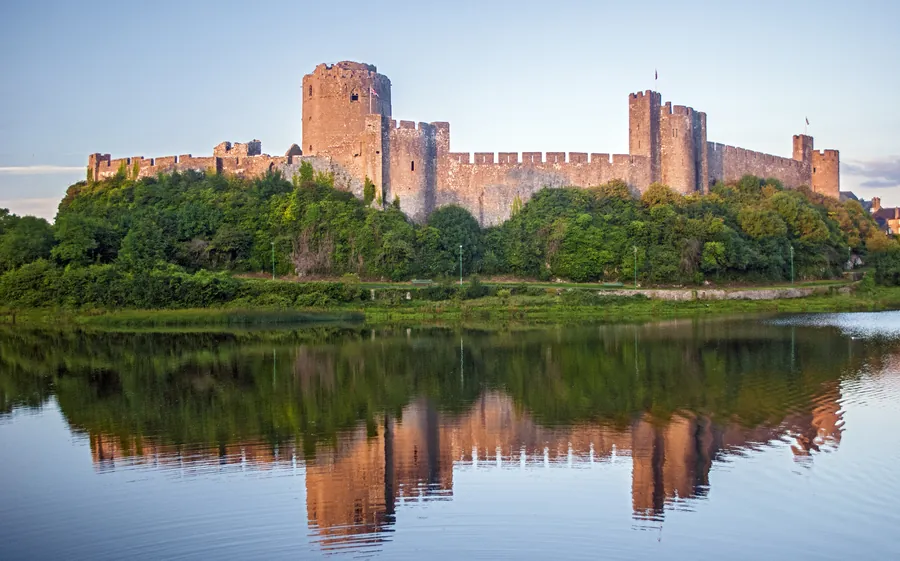
Pembroke Castle stands on a rock almost surrounded by water at the head of the Pembroke River, fifteen kilometres west of Tenby, and it is the biggest and best castle within reach of the town.
Founded in 1093, rebuilt in stone from around 1200 by William Marshal — regent of England and, by the reckoning of his contemporaries, the greatest knight in Europe — it is Grade I listed and was extensively restored in the early twentieth century, which is why so much of it can actually be walked.
Marshal’s keep is the outstanding thing here: a cylindrical tower 24 metres high with walls up to six metres thick at the base and a stone dome over the top, which is very unusual and is a large part of why it has survived intact.
Four storeys, climbable, with a view from the parapet over the town, the estuary and the country beyond.
Round keeps were the state of the art around 1200 — no corners to undermine, better deflection of missiles — and Pembroke’s is among the finest anywhere.
On 28 January 1457, in a tower of this castle, Margaret Beaufort — thirteen years old and already a widow — gave birth to Henry Tudor.
Twenty-eight years later he landed at Milford Haven a few miles away, marched through Wales gathering support, and killed Richard III at Bosworth. As Henry VII he founded the Tudor dynasty.
The Henry VII Tower is identified as the birthplace and is where most visitors go first.
Beneath the castle courtyard, reached by a spiral stair, is a large natural limestone cave open to the river.
It was occupied in the Palaeolithic and used through prehistory into the medieval period as a store and a boat house, with a water gate giving direct access to the river beneath the walls. It is a genuinely strange space and one of the most memorable parts of a visit.
Guided tours run by castle staff are included in the admission and are, by universal report, excellent — knowledgeable, entertaining and worth planning around.
Take one. Visitors who do rate the visit far more highly than those who wander alone.
Events run through the summer, including falconry displays and re-enactments.
Arrive early — visitors report walking straight in before mid-morning and queuing later.
Worth passing on: the signed “Castle Parking” leaves you with a steep climb up to the entrance. There is parking on the level nearer the gate if you look rather than follow the signs.
Admission charged, tours included.
Time: two to three hours.
Facilities: café, shop, toilets.
Access: the courtyard is level; towers and keep are spiral stairs, and the cavern is down a stair.
Getting there: in the centre of Pembroke, about twenty-five minutes from Tenby by road. Pembroke station is a short walk, on the same line as Tenby.
Carew Castle is fifteen minutes back towards Tenby, and the two make a natural day.
The Cleddau estuary and Milford Haven are close by.
Bosherston Lily Ponds, Broad Haven South and St Govan’s Chapel are south on the Castlemartin coast.
Henry VII, on 28 January 1457, to the thirteen-year-old Margaret Beaufort.
Yes — guided tours by castle staff are included in the admission and are strongly recommended.
Wogan’s Cavern, a large natural limestone cave beneath the courtyard, occupied since the Palaeolithic and later used as a store and boat house.
Two to three hours.
Fifteen kilometres west, about twenty-five minutes by road, with a train on the same line.