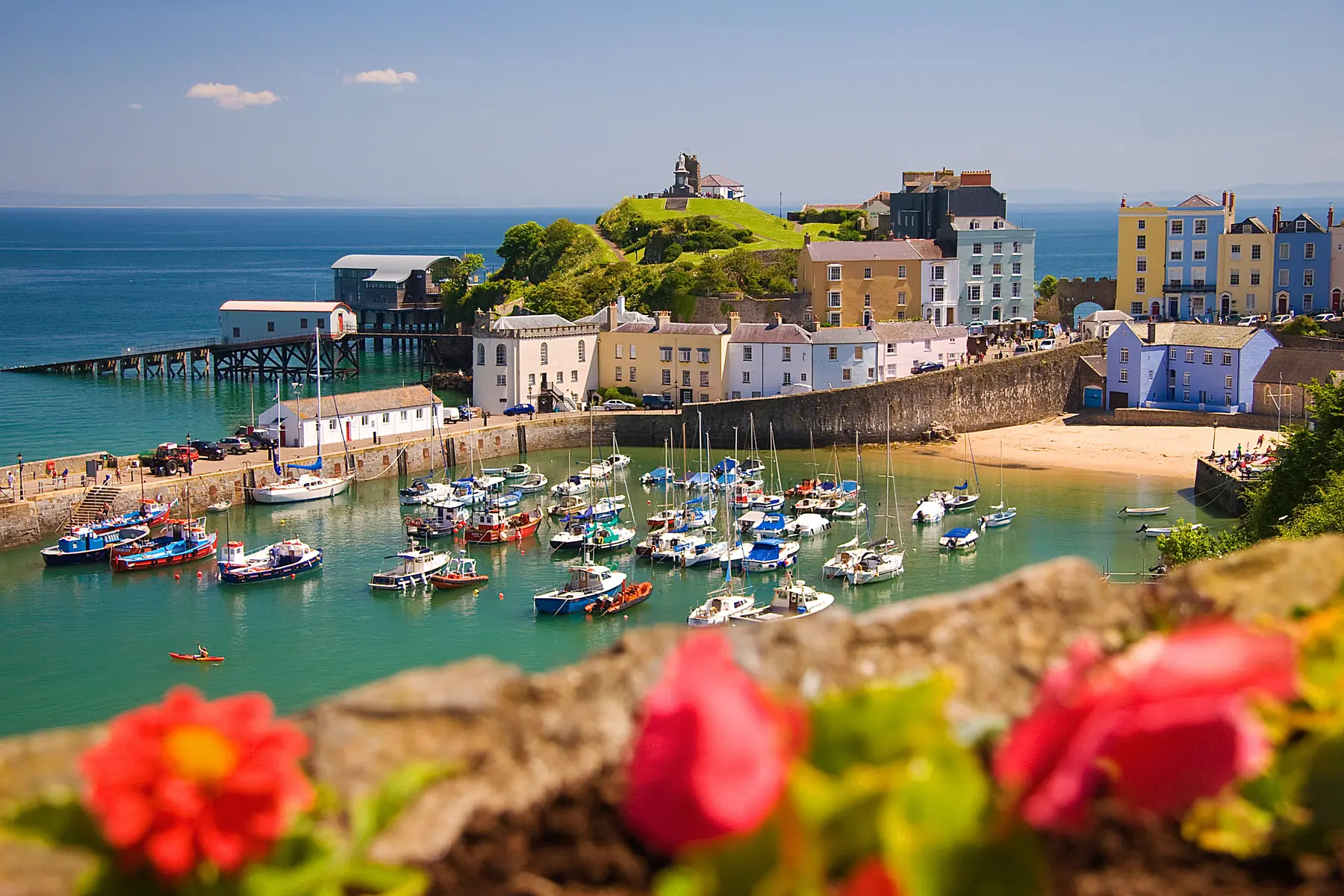
Three kilometres off Tenby, across a strip of water called Caldey Sound, sits a small island with a working Cistercian monastery on it. Monks have lived there, on and off, since the sixth century; the present community farms the island, makes perfume from its wildflowers and chocolate in a small factory, and runs the place.
Boats cross from Tenby harbour in about twenty minutes, and a visit takes half a day. It is one of the more unusual things you can do on a British seaside holiday, and it is entirely unlike the town you have just left.
Boats run from Tenby harbour — at high tide from the harbour itself, at low tide from Castle Beach, which is worth knowing when you go to buy a ticket.
The service runs from around Easter to the end of October, Monday to Saturday. It does not run on Sundays, out of respect for the community, and it does not run in wind or swell. There is no need to book far ahead in most conditions; buy tickets at the harbour kiosk on the day.
The crossing takes about twenty minutes and lands at a jetty on the island’s northern shore.
A monastic community was founded on Caldey in the sixth century, and the island has been in and out of religious hands ever since. The present abbey — a startling white Italianate building that looks as though it has been imported from somewhere much warmer — was built in the early twentieth century by Anglican Benedictines, who then converted to Roman Catholicism. Cistercians from Belgium took over in 1929 and have been there since.
The abbey church is open to visitors at set times and the monks sing the offices through the day; visitors may attend. The rest of the monastery is enclosed and private, which is the point of a Cistercian house.
The Old Priory and St Illtud’s Church — the medieval buildings that preceded the abbey, with a leaning spire and, inside, the Ogham Stone, a sixth-century inscribed stone with both Ogham and Latin lettering.
St David’s Church, the parish church, in the village.
The village itself — a small cluster of houses, a post office, a tea garden and the shops.
The perfumery, where the monks make perfume from the island’s gorse, lavender and wildflowers, and the chocolate factory. Both sell what they make, and the shop is where a good proportion of the island’s income comes from.
The lighthouse, on the highest point, built in 1829 and reached by a walk of about a kilometre with views back to the mainland and out to sea.
Priory Beach, a sheltered sandy beach below the village.
The walks — a network of paths round the island, through woodland and along the cliffs, taking one to two hours for a full circuit.
Quieter than you expect. The island is a mile and a half long, there are no cars beyond the community’s own, and the pace changes as soon as you land. A good many visitors describe it as the most peaceful few hours of their holiday, which is not a claim seaside day trips usually attract.
It is also not a heritage attraction dressed up as a working monastery — it is a working monastery with visitors on it. The enclosure is respected, photography is restricted in places, and the community asks for reasonable quiet near the abbey.
Time. Boats run through the day; most people spend three to four hours on the island, which is enough for the abbey, the priory, the lighthouse walk, the beach and the shops.
Facilities. A tea garden, a café, the shops and toilets in the village. No pub, no bank and limited signal.
Terrain. The paths are unsurfaced and the lighthouse walk is a gradual climb. Sensible shoes.
Dogs are generally not permitted on the island. Check before travelling with one.
Sundays. No boats.
Weather. Crossings are cancelled in wind and swell, sometimes at short notice. Do not save Caldey for your last day.
Money. Take some — the shops and tea garden are the island’s livelihood and card acceptance can be limited.
The perfume is the island’s signature product and is made from its own gorse and lavender. The chocolate, made by the monks in the island factory, is the other. Both are sold in the village shop and both make better souvenirs than most of what is on sale in Tenby.
Caldey works well as a half day, leaving the morning or afternoon free for Tenby’s beaches or the walled town. Boat operators also run round-island cruises that do not land, and coastal trips along the Pembrokeshire shore, which are worth considering if the landing service is full or if you want an hour on the water rather than an afternoon on an island.
Our Tenby beaches guide and our day trips guide cover what to do with the rest of the day.
Worth knowing before you go, because the island’s story is longer than the abbey suggests.
A Celtic monastery was founded here in the sixth century, associated with St Samson and St Illtud, and the Ogham Stone in the old priory church — inscribed in both Ogham and Latin — dates from that period. Vikings raided it; the name Caldey is Norse.
Benedictines from St Dogmaels held it through the Middle Ages until the Dissolution, after which it passed through private hands for three and a half centuries and was farmed.
In 1906 an Anglican Benedictine community bought it and built the present abbey — the white Italianate building that looks so unexpected in a Welsh seascape. In 1913 most of the community converted to Roman Catholicism. Financial difficulties followed, and in 1929 Cistercians from Belgium took over. They have farmed the island and run it ever since.
That is a very long continuity for a small island, and it is why the place feels the way it does.
Book early in your stay, not late. Crossings are cancelled for wind and swell with little notice, and if Caldey is the thing you most want to do, giving yourself two or three possible days is the difference between going and not.
Check the boarding point. Boats leave from the harbour at high tide and from Castle Beach at low tide, which catches out people who go to the wrong place with tickets in hand.
Take cash. The village shops, the tea garden and the perfumery are the island’s income and card acceptance can be patchy.
Allow for the walk. The village, the abbey and the priory are all close to the jetty; the lighthouse is a kilometre uphill. Three hours is comfortable, four is better.
Layers. It is an island in the Bristol Channel and it is colder on it than in Tenby.
By boat from Tenby harbour — from Castle Beach at low tide — taking about twenty minutes.
Roughly Easter to the end of October, Monday to Saturday. There is no Sunday service, out of respect for the monastic community.
Three to four hours covers the abbey, the priory, the lighthouse walk, the beach and the shops.
The abbey church is open to visitors at set times and you may attend the offices. The rest of the monastery is enclosed and private.
Perfume from the island’s wildflowers, and chocolate. Both are sold in the village and are the island’s main source of income.