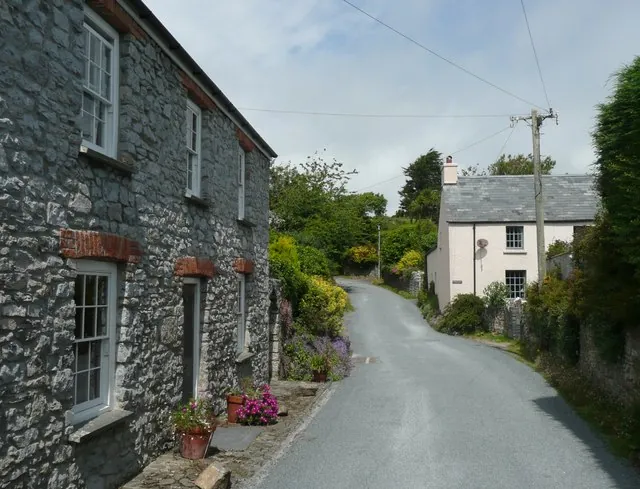
Manorbier is a village, community and parish on the south coast of Pembrokeshire, inside the Pembrokeshire Coast National Park. The name means the ‘Manor of Pŷr’. The reason to make the trip from Tenby is how tightly three things sit together: a Norman castle, a sandy bay below it, and a prehistoric burial chamber on the ground south of the beach. One car park serves the first two.
The straight-line distance from Tenby is 7.3 km. Wikipedia gives no road distance for the village, but it does record the rail link — Manorbier has its own station on the same branch line that serves Tenby, and that station is 6.3 km straight-line from the centre of Tenby.
The community takes in Jameston, Lydstep and Manorbier Newton, and the electoral ward of the same name reaches inland as far as St Florence; the ward population at the 2011 census was 2,083. The village a visitor means, though, is a short run of road down to the bay rather than a town. Wikipedia lists what people come for: the castle, St James’s Church, the sandy beach, the cliffs, and the stretch of the Wales Coast Path that passes through.
Manorbier Castle is the one rated attraction in the village, at 4.5 from 1,449 Google reviews. Its first form was motte and bailey, thrown up after the Norman knight Odo de Barri was granted the lands of Manorbier, Penally and Begelly in gratitude for military help in conquering Pembrokeshire after 1103. The stone walls came in the next century, added by later Normans.
Parking, and the way in, is what reviewers keep explaining to each other. A visitor in July 2026 wrote, “Park at beach car park, turn right and cross road into secret garden to gain entrance. Very limited parking otherwise.” Another, also in July 2026, described the same arrangement from the other side: “The beach is beautiful, and the same car park serves both the castle and the beach, which is really convenient.”
Set expectations by scale. That second July 2026 visitor was direct about it: “Manorbier Castle isn’t one of the largest Welsh castles, especially when compared with places like Caernarfon Castle”. Entry is charged, and reviewers who mention the charge treat it as proportionate to the size of the place.
Not every visit goes well. A visitor in August 2026 left three stars and wrote, “Lovely location shame about staff. I hope we just caught them on a bad day,” while finding the tea room food good. The castle is also a working venue and a holiday let: a July 2026 visitor arrived to find a large tent going up for a wedding, noted a twelve-bedroom cottage and private garden available on site along with pirate-themed activities for children, and still called it “The most spectacular venue I have ever visited”. A wedding can be in progress when you turn up.
The beach is sandy, and the cliffs beside it do something worth looking at closely: along the cliffs to the side of the beach, the rock formations are revealed as vertical beds. Fossils can be found along the stream bed, though Wikipedia enters its own caveat — some of them are of poor quality. Treat fossil-hunting here as a bonus rather than the reason for the journey.
The oldest thing to walk to is the King’s Quoit, a cromlech south of Manorbier bay and beach. The wider parish is dense with the same deep past, though little of it is on show: the many flint microliths from the Mesolithic and Neolithic ages found here are housed in local museums rather than left in the ground. A perforated mace head points to occupation of The Dak; there are Bronze Age burial mounds on the Ridgeway, an Iron Age enclosure near Manorbier station, and the site of a multivallate promontory fort — multivallate meaning multiple ditches — at Old Castle Head, where remains of hut platforms survive inside the ditches.
Two later features sit close to the village. A well-restored lime kiln stands in Mud Lane behind the castle. East of Manorbier, on the side of the road to Lydstep, is an area of strip lynchets dated to early Anglo-Saxon times and perhaps as early as the Bronze Age.
The village’s best-known son is Giraldus Cambrensis, also known as Gerald of Wales, born here around 1146 and dead around 1223 — a Cambro-Norman priest and historian, son of William de Barri, who called the place “the pleasantest place in Wales”. Manorbier has been quoting him ever since.
St James’s parish church dates from the 12th century and is a Grade I listed building. A large number of other buildings and structures in the parish are listed as well.
In late August 1908 the writer Virginia Woolf stayed in Manorbier, on her own, at Sea View cottage, and worked there on her first novel, The Voyage Out.
The 20th century left a harder mark. From 1933 until 1 September 1946 a mixed civil and military airfield operated here, serving during the Second World War as RAF Manorbier. The site is now a firing range, employed by the Royal Artillery as a testing range for high-velocity missiles — so this is not an entirely open coastline.
The scale of the place shows in its football club: Manorbier United FC played in the Pembrokeshire League from 1970 until folding partway through the 2017–18 season, and reformed in 2024.
The train is the public transport link, and it is a real one. Manorbier railway station sits on the Pembroke Dock branch of the West Wales Line, operated and managed by Transport for Wales Rail. Trains stop here on request every two hours in each direction — westwards to Pembroke Dock, eastwards to Tenby, Whitland, Carmarthen and Swansea. Tenby’s own station is at the other end of that short hop, about a four-minute walk from the town centre and unstaffed, so sort a ticket before you reach the platform. The Pembroke Dock branch runs a reduced service compared with the core West Wales Line, so check the current timetable before building a day around it.
No bus route between Tenby and Manorbier is established in the sources behind this page, so do not plan on one.
For cycling, Pembrokeshire Bike Hire rents hybrid, electric and road bikes and will either hand them over at Manorbier itself or deliver them to your accommodation — the one hire arrangement around Tenby that can start at this end rather than in town.
On foot, the village carries part of the Wales Coast Path, the approach for anyone walking this stretch of coastline rather than travelling to Manorbier in itself.
The village and what is around it, at walking scale.
Open any of them in Google Maps for directions and current opening.
Attractions, prices and availability in Tenby
These come from GetYourGuide's booking widget, which sets their cookies in your browser. Consent to load it and see the attractions and prices.
Background on Manorbier draws on its Wikipedia article, text there being available under CC BY-SA 4.0.