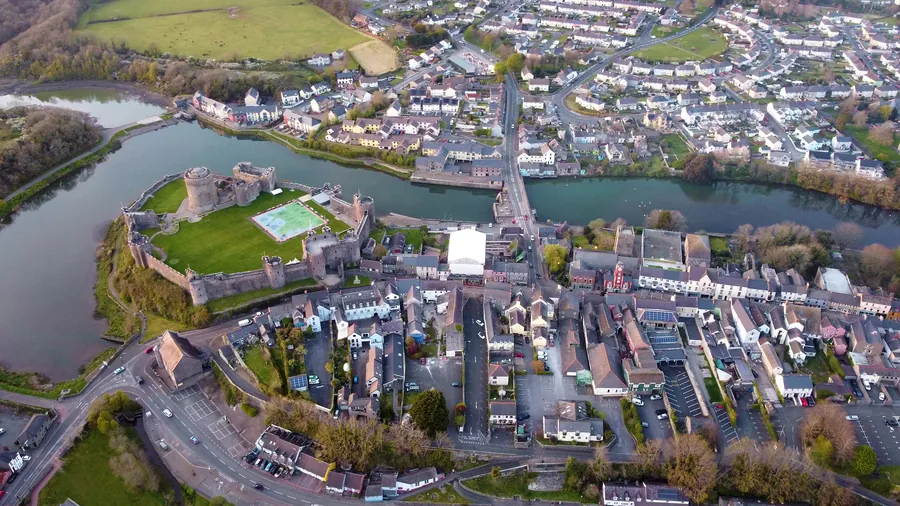
Pembroke stands on the south Pembrokeshire limestone peninsula by the estuary of the River Cleddau, flanked on all sides by woodland and arable farmland. What draws people over from Tenby sits at the western tip of that peninsula, with water on three sides: Pembroke Castle, the substantial remains of a stone medieval fortress founded by the Normans in 1093, seat of the Earls of Pembroke and birthplace of Henry Tudor, who became Henry VII of England.
This is a town rather than a village: 7,552 people, and with Pembroke Dock next door a combined 15,890, one of the major population centres of West Wales. Town and county share a name drawn from the cantref of Penfro — pen, ‘head’ or ‘end’, and bro, ‘region’ or ‘land’ — read as either ‘Land’s End’ or ‘headland’.
The straight-line distance from Tenby is 14.9 km. Wikipedia gives no road distance between the two; it places Pembroke 8 miles (13 km) south of Haverfordwest and the ferry port of Pembroke Dock 3 miles (4.8 km) to the north-west.
Gerald de Windsor was the first recorded Constable, and the castle was enlarged until a final extension about 1254, after which the town itself was walled. It carries 4.7 from 8,254 Google reviews, and reviewers write about the sheer amount of it to get around. A visitor in August 2026 described “lots of towers to climb and a cave to view”, and added: “Free tours of the castle for those that love history. Different events take place over the summer months eg falconry.” The consistent complaint is orientation: another visitor in August 2026 found rooms and chambers on several floors but “no clear signage indicating the most appropriate chronological route to take.”
Parking has a trap: following the signed route for castle parking leaves you walking up a steep slope. A visitor in July 2026 gave the alternative — “there’s a small, slightly cheaper car park almost opposite the castle entrance. Spaces are limited though.”
Main Street is the only street inside the original town walls, which survive on their medieval foundations although much rebuilt over the centuries. A great many of the town’s medieval burgage plots survive too, divided by early stone walls described as of significant national importance. Housing outside them runs north towards Pembroke Dock, east towards Lamphey and south, with Monkton village to the west.
The first stone building in the town was a defensive tower built on a cliff edge, now known as the Medieval Chapel, at 69a Main Street. Its layout matches St Govan’s Chapel, so it is thought to have served as an early church; John Wesley used it to preach Methodism in 1764. In 1866 it became the brewery for the York Tavern, which had briefly been Oliver Cromwell’s headquarters at the end of the Siege of Pembroke during the English Civil War.
Pembroke Museum covers this ground but is small, at 4.4 from 14 Google reviews — too few to weigh. Local life runs through Pembroke 21C in Foundry House on the Commons, which runs the annual Pembroke Festival and the fortnightly farmers’ market; the library shares a building with the Tourist Information Centre.
The town’s main bridge over the River Pembroke doubles as a dam and holds the millpond in place. The first bridge was built to house a tide mill, granted to the Knights Templar in 1199; the last mill building was destroyed by fire in 1956. The water is a walk in its own right, listed as Mill Pond Walk at 4.7 from 7 Google reviews, a handful; Paddle West Castle Row Boats, a canoe and kayak tour agency, carries 5.0 from 90.
Across the river on a hill stands Monkton Priory, founded in 1098 by Arnulf de Montgomery and granted by him to the Benedictine order; it keeps much of the Norman walling of its nave, the choir and sanctuary renovated in the nineteenth century. Beside it is Monkton Hall, regarded as the oldest domestic building in Pembrokeshire and possibly in Wales, and thought to have been the guesthouse for visitors to the priory. It appears as Monkton Old Hall at 4.8 from 26 Google reviews. Both banks west of the castle carry older industry: quarries, and medieval and Elizabethan slipways where wooden vessels were built long before the industrial dockyard.
Pembroke Dock is the other half of the day: an admiralty town established in 1814 and laid out on a grid, with an early submarine base at Pennar Flats used for submarine warfare experiments.
The Pembroke Dock Heritage Centre, 4.7 from 381 Google reviews, is specialised. A visitor in July 2026 put it plainly: “This is the museum to come to if you have an interest in flying boats, especially with regard to the second world war.” A visitor in June 2026 noted the shipbuilding exhibits and a “display around the building of the millennium falcon for the Star Wars movies”; another that month found “plenty of free parking”.
The West Wales Maritime Museum, 4.8 from 109 Google reviews, is volunteer-run, and its reviews are mostly about the volunteers: a visitor in July 2026 called them “wonderful people who give their time to worthwhile causes”. The same month brought a one-star account worth reading first — “Not a disabled friendly venue, infact disabled people appear not to be welcomed.” Access is worth confirming first.
By train, Tenby’s station is on the Pembroke Dock branch of the West Wales Line, operated by Transport for Wales, running south-west towards Manorbier and Pembroke Dock; a live check on 21 July 2026 returned real scheduled departures to Pembroke Dock. The branch runs a reduced service compared with the core West Wales Line, and Tenby’s station is unstaffed, so check the current timetable first. The pack establishes only the Pembroke Dock end of that branch, not a station in Pembroke town, and no bus between Tenby and Pembroke — check locally rather than assume.
By bike, National Cycle Network Route 4, the Celtic Trail, passes through Tenby on a corridor running from Chepstow and Newport via Swansea, Carmarthen, Pembroke and Haverfordwest to Fishguard. Riding it is no casual outing: Komoot lists a Tenby Harbour to Pembroke Castle loop as a difficult 36.1-mile route with over 600 m of climbing. Hire is available in Tenby itself, at Pembrokeshire E Bike Hire on Harries Street.
The village and what is around it, at walking scale.
Open any of them in Google Maps for directions and current opening.
Attractions, prices and availability in Tenby
These come from GetYourGuide's booking widget, which sets their cookies in your browser. Consent to load it and see the attractions and prices.
Background on Pembroke draws on its Wikipedia article, text there being available under CC BY-SA 4.0.