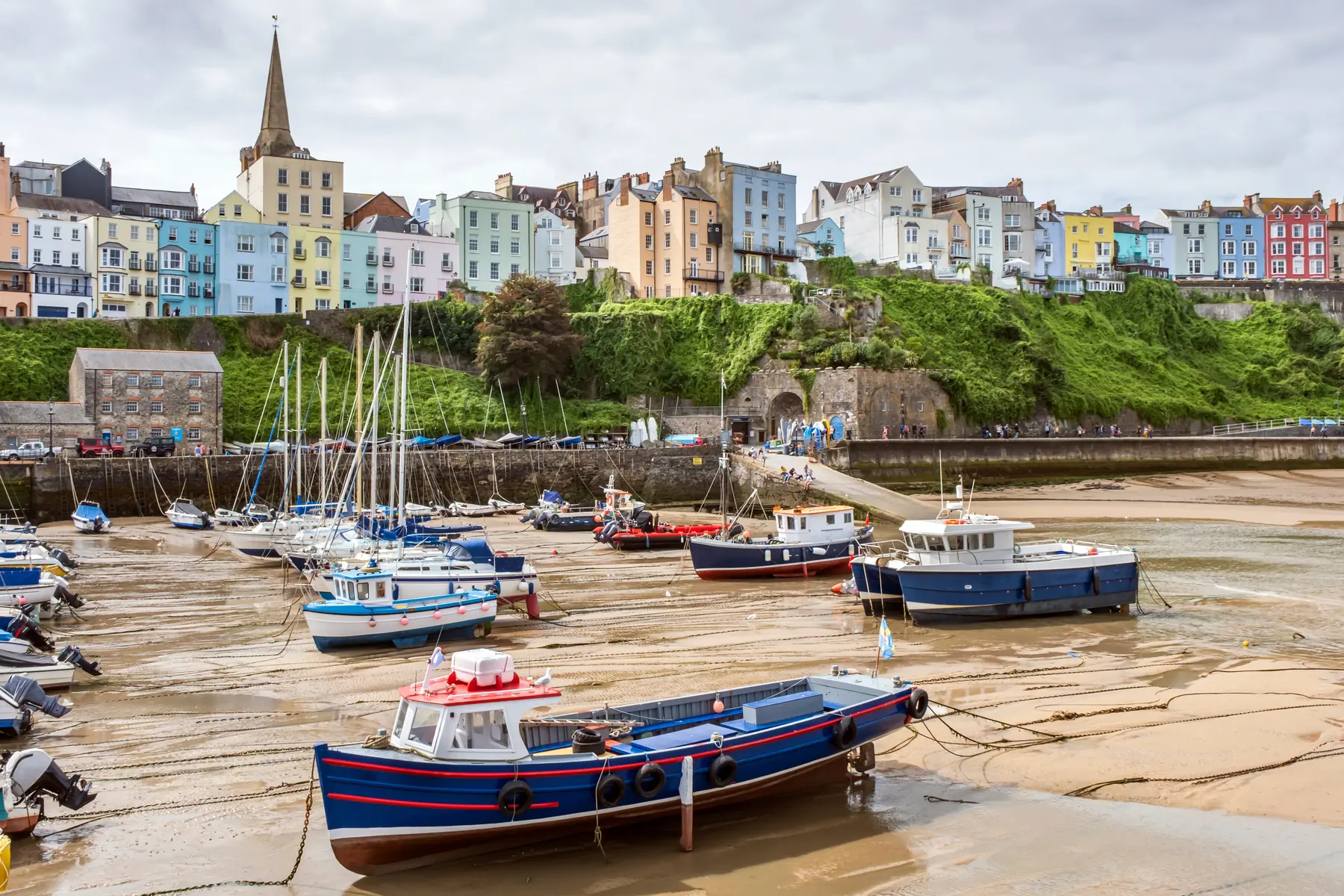
Tenby is famous for beaches, and the harbour is the thing those beaches were built around. It sits in a small tidal basin under the pastel houses, Castle Beach on one side, North Beach on the other, and Castle Hill as the rock in between. Boats still work it. Caldey boats still leave from it. At low water they sit on the sand.
It is not a paddling beach. Harbour Beach — the pocket of sand beside the wall — is covered in the beaches guide. This page is the quay.
The Welsh name is Dinbych-y-Pysgod, the little town of fishes, and that is still the job. Crab and lobster pots come in. Mackerel trips go out in season. Ice, diesel, a slipway and a row of boats that earn a living share the same water with the trip boats and the people taking photographs.
Come to look. Come to eat what came in. Leave the sand for Castle Beach and South Beach.
The inner basin dries. That is the fact a postcard of floating boats does not mention. Springs leave keels on the sand and a wide foreshore where the water was. Neaps leave less of a show. Both are worth seeing. Neither is a surprise if you have looked at a tide table.
Stand on the quay, not on a working deck. Pots, ladders and boats being loaded are not climbing frames.
Tenby has a large tidal range, and the harbour is the clearest demonstration of it in the town. At low water the basin is a sandy floor with boats standing on it. The walk around the wall becomes a walk across the sand if you pick your way, and Castle Beach and North Beach effectively join it into one stretch.
That is the photograph: keels, pastel houses stacked on the cliff, Castle Hill to the right, St Catherine’s Island beyond. It is also when the Caldey boats cannot use the harbour steps and move the boarding point.
At high water the picture reverses. Boats float. The harbour looks like a harbour. Harbour Beach and much of North Beach go under. Trip boats leave more easily. The island offshore is actually an island.
Get the tide table on the first morning. Every shop in Tenby sells one. Plan the harbour for the state of the water you actually want, not for the hour you happened to park.
This is the harbour’s other job, and it is why a lot of people are standing on the quay with tickets.
Boats to Caldey Island leave from Tenby harbour at high tide and from Castle Beach at low tide. The crossing is about twenty minutes. The service is seasonal — typically Easter to the end of October — Monday to Saturday, not Sundays, and not in wind or swell. Buy tickets at the kiosk on the day in most conditions; check the operator the night before if Caldey is the thing you came for.
The classic mistake is going to the harbour with tickets in hand when the tide has already dropped and the boats have moved round to Castle Beach. The second is saving the crossing for the last morning of the week, when a westerly cancels it.
Our Caldey guide is the island. This page is only saying: the harbour is the departure point, until it isn’t.
Round-island cruises that do not land, and short coastal trips, use the same quay. They cancel for sea more often than for rain. Ask on the wall that morning. The skippers are the authority, not a screenshot.
The harbour sits under the headland. Tenby Castle is the fragment on top: a thirteenth-century tower and wall, the Prince Albert memorial, and the best view in the town — North Beach one way, the harbour and Castle Beach the other, Caldey offshore, St Catherine’s Island immediately below.
It takes ten minutes from the quay. The path from the harbour up onto Castle Hill is the historical sequence: port first, fortress above, resort later. Tenby Museum and Art Gallery sits in the castle’s former grounds and charges; the hill itself is free.
Do the hill early, before the day visitors fill the benches, or late, when the light comes round onto the houses. The harbour from above is a different picture from the harbour on the sand.
Castle Beach is the cove on the south side of the headland, between the harbour and South Beach, with the lifeboat slipway at one end and St Catherine’s Island offshore.
It is not the harbour. It is the next place, two minutes round the point, and it is the right sand if you have done the quay and want to sit. Rock pools at low water. The island walkable on a falling tide and cut off on the flood. People misjudge that every summer.
Combine them on the tide: harbour while the boats are moving or while they are dry, Castle Beach as the water drops, back up the hill when you are done. You do not need to relocate a car. The parking guide is blunt about the harbour bays — permit and short-stay, not a plan after breakfast.
The pastel Georgian houses on the cliff are the other half of the picture, and they are still houses. The lanes down to the harbour — Quay Hill, St Julian’s Street, Bridge Street — are steep, and in summer they are full. The Tudor Merchant’s House on Quay Hill is the National Trust building in the mix; the rest is town.
Stay off working gear. Do not swim in the harbour — Castle Beach and South Beach are the swimming sand. Watch your feet on the steps and the harbour wall, which are wet, weedy and unforgiving. Keep dogs on a lead on the quay. Fishing from Tenby’s harbour wall is a local habit around high water; do not cast across a Caldey boat that is coming in.
The harbour car park is not visitor overflow. Park in the multi-storey on Upper Park Road and walk down, or come on the train and walk from the station. Our without a car piece is that arrival.
Tenby RNLI sits on the Castle Beach side of the headland, launching down a slipway into the sea rather than out of the drying basin. That is why it is there. The all-weather boat and the inshore boat cover Caldey Sound, Carmarthen Bay and a long stretch of this coast.
The station is free to look at. It is a workplace. A shout is not a display. If the doors are open and the crew are moving, give them the slipway.
The older boathouse on the north side of Castle Hill, on screw-piles over the sand, is part of the same story: Tenby could not launch from the harbour at all states of tide, so the station moved onto the point. You walk past it on the way up to the castle.
The shape that works: down to the harbour first, while it is still itself. Then up onto Castle Hill for the view. Down to Castle Beach as the tide drops, and across to St Catherine’s Island if the water has left you the sand. Back through the walled town for lunch. South Beach is a different outing, on the other side of the headland; it does not need the harbour, and the harbour does not need it.
A wet version swaps the island for the museum and a harbour pub. The basin is more itself in a blow than in August sunshine. See Tenby in the rain. The eating guide is the rest of a quay lunch — crab from the water you are looking at, if the day has been a landing day.
Early on a working morning, for the fleet rather than the ice cream. Low tide, if the point is boats on the sand and the walk to Castle Beach. High tide, if the point is Caldey leaving and the basin full. September, when the town has thinned and the harbour has not.
Winter storms make the cove a spectator sport from the wall and from Castle Hill, at a sensible distance from the edge. Do not stand on the seaward end when the sea is coming over it.
Tide tables are essential for Caldey boarding, the island crossing and any idea of sitting on Harbour Beach. Food on the quay is seasonal and small; the old town is five minutes up the hill. Without a car this is one of the easier visits in Pembrokeshire: the station is a short walk, and the harbour is downhill.
The harbour is the reason there is a town here at all. The beaches made it a resort. You can do the harbour and Castle Beach in an hour if you pick the tide, and you should.