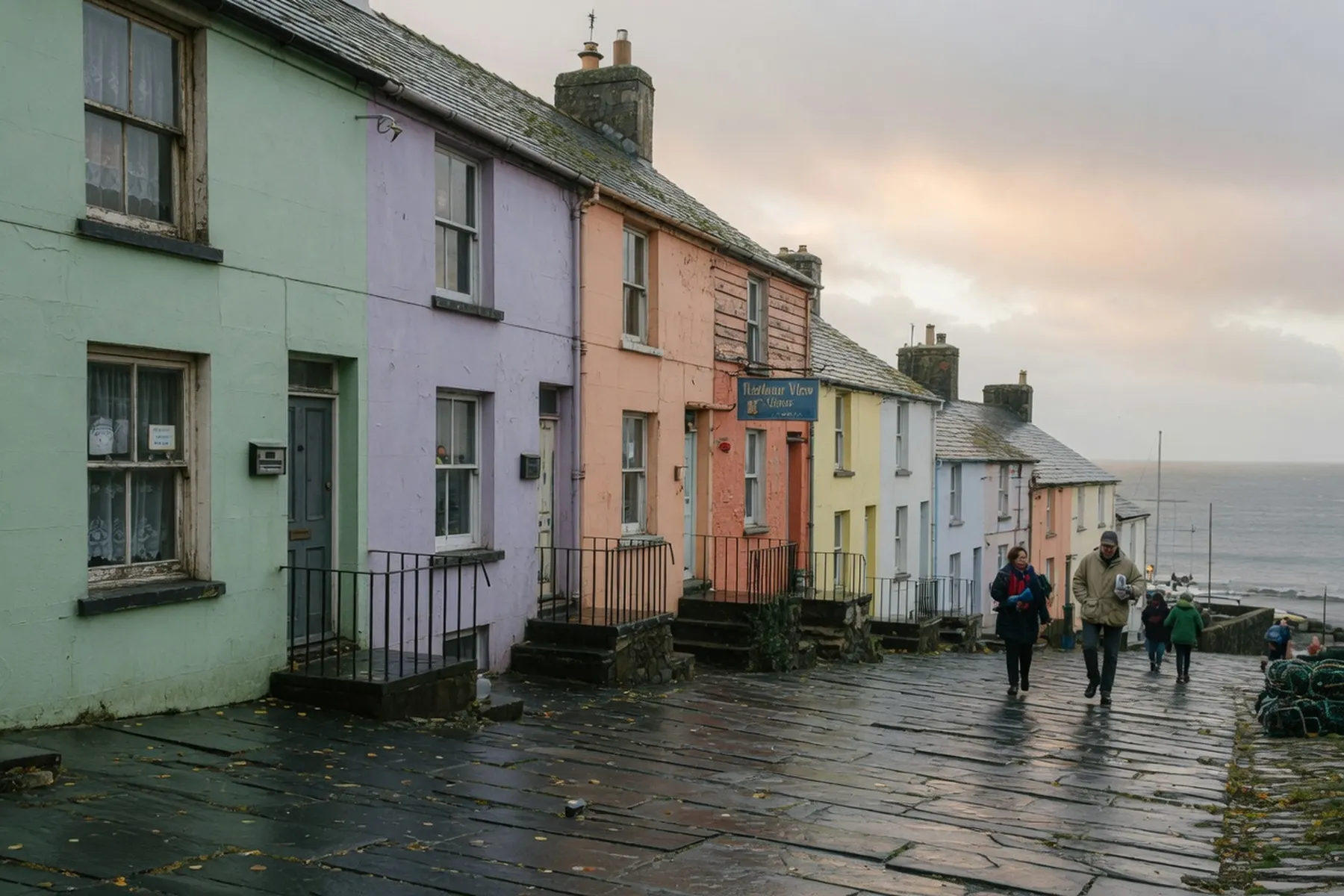
From the top of Castle Hill to the sand at South Beach, Tenby’s best days out are mostly free. The town keeps its four beaches open without an admission charge, the medieval walls that wrap the old town cost nothing to walk, and the harbour is a show you watch from the quay for as long as you like. What you pay for in Tenby you should pay for deliberately: a pasty on St George’s Street, a day ticket on the bus, and one boat trip that is worth every penny of its fare. This guide sets out exactly what costs nothing, where to eat without reading a menu backwards, how the buses work, and which single paid trip deserves the money — with the operator named wherever a price or a date can change.
The four beaches — North, Castle, South and Harbour — are free all year, and the town council describes them as “miles of European Blue Flag winning beaches”. There is no gate, no wristband and no season ticket: you walk down the slipways and you are on the sand. The working harbour is free to watch too, and it is the best show in town on a working day, with the fishing boats drying out on the sand at low water and the Caldey boats coming and going from the quay in season. The town walls are the same. Built in the 13th century by William de Valence, Earl of Pembroke, after Welsh attacks on the town, they still stand around the old town and remain an open, free circuit rather than a ticketed monument. The free-things guide lists the rest of what costs nothing, and the beaches guide sorts the four beaches by what each one suits.
The surviving wall runs along South Parade, and the centrepiece is the Five Arches, the barbican gate that still frames the way into the old town. You can walk the stretch at your own pace — allow about 45 minutes around the old town — and stop where the wall opens toward the sea or drops you back into a narrow street of painted houses. Tenby’s Welsh name is Dinbych y Pysgod, “little fortress of the fish”, and the walls are why the little fortress still reads as one. It is the same walk in October as in July, and nothing about it changes with the season, which is most of its appeal. The walls guide goes through the Five Arches and the walk inside in detail.
The shop to know is the Pembrokeshire Pasty & Pie Co at 1 St George’s Street, which makes the original Pembrokeshire pasty and keeps its hours and menu on its own page. Around it, the budget circuit runs through Tenbys Fish & Chips on Trafalgar Road, Park Road Fish & Chip Shop, Loafley Bakery & Deli, and the café in the Tenby Indoor Market; Fecci’s ice cream is the long-standing sweet stop. This article names the businesses but not their prices, because menus move faster than any guide can follow — check the board or the venue’s own page before you order, and treat Where to Eat as the fuller map of the town’s food.
For several days of moving around, the West Wales Rover is the cheap way to do it: a day or week ticket covering bus travel across west Wales, Pembrokeshire included. The price lives on traws.cymru, where you buy and where the figure is current, so check there rather than trusting a printed one. For the run to Saundersfoot in summer there is the Tenby Coaster, the open-top bus, with 2026 fares of £7.30 for an adult day ticket, £3.00 for a child, and £18.20 for a group of up to five; a return from Tenby to Saundersfoot is £5.90 adult and £2.00 child, and concessionary pass holders travel free. The Coaster is seasonal — the 2026 season ran roughly from late May to late August — so check First Bus for the current year’s dates before you build a day around it. The no-car guide covers the train and the rest of getting around without driving.
The Caldey Island ferry is the paid trip that earns its fare. It is a landing boat, not a cruise: about twenty minutes out of Tenby harbour to a monastery island, and the crossing itself is part of the draw. The 2026 fares are £24.95 for an adult, £21.95 for a senior or carer, £12.95 for a child aged four to fifteen, free for under-threes, and £64.95 for a family. Tickets are sold day-only at the Castle Square kiosk, and the boats stop at the end of September, so a visit in October or later means no Caldey until the next spring. That season is the one thing to plan around; the Caldey guide sets out the boats, the monastery and the island in full.
The months either side of winter fill Tenby with events that are cheap or free to watch. The Tudor Merchant’s House runs its “Nadolig Tuduraidd / A Tudor Christmas” every Friday and Saturday from 27 November to 12 December 2026, with the house dressed in greenery, staff in Tudor costume and a free gift for children under ten while stocks last — normal admission applies and last entry is 2.30pm, with no booking; check the National Trust’s page for the house. Tenby Blues Festival fills the town from 13 to 15 November 2026, and the line-up and ticket prices live on tenbyblues.co.uk. The Christmas Market, Santa Run and lights switch-on fall together on Saturday 28 November, with the confirmed time on Tenby Town Council’s events page at tenbytowncouncil.co.uk. The Boxing Day Swim on North Beach follows on 26 December, with entry and donation details on tenbyboxingdayswim.co.uk.
Autumn is the quiet answer to Tenby’s summer prices. The boats to Caldey stop at the end of September, and with them goes a chunk of the day-trip crowd, while the beaches, walls and harbour stay exactly as they were. School holidays and August are when everything from rooms to fish suppers runs at its peak; a midweek in October gets you the same tide and the same walls with far less competition for them. The trade-off is the one already stated — no Caldey after September — and when to visit weighs the seasons in more detail.
The saving is not only in what you buy; it is in what stays the same for nothing. The beaches do not charge more in August than they do in February because they never charge at all, and the walls ask nothing of you in any month. What changes is the pressure around them — the queues at the pasty shop, the bus that is fuller than you planned, the sand that is harder to find a quiet patch of. Visiting in the shoulder weeks costs you nothing extra and buys back most of the room the summer crowd takes.
The Tudor Merchant’s House on Quay Hill, the National Trust’s 15th-century townhouse, is the one indoor stop where paying is worth it — admission is charged, members go free, and the NT page carries the current price. But much of what surrounds it costs nothing, and the sensible order is to do the free things first: the harbour and Castle Hill above it, the walls, the beaches. Tenby’s colour is cheap too. The town claims the first oranges to land in Wales, brought by Portuguese seamen in 1566, and St Mary’s Parish Church is said to be the largest of its kind in Wales; it is a host town of Ironman Wales and a founding member of the Walled Town Friendship Circle. None of that asks for a ticket. The Tudor Merchant’s House and Museum guide covers the house and the museum beside it.