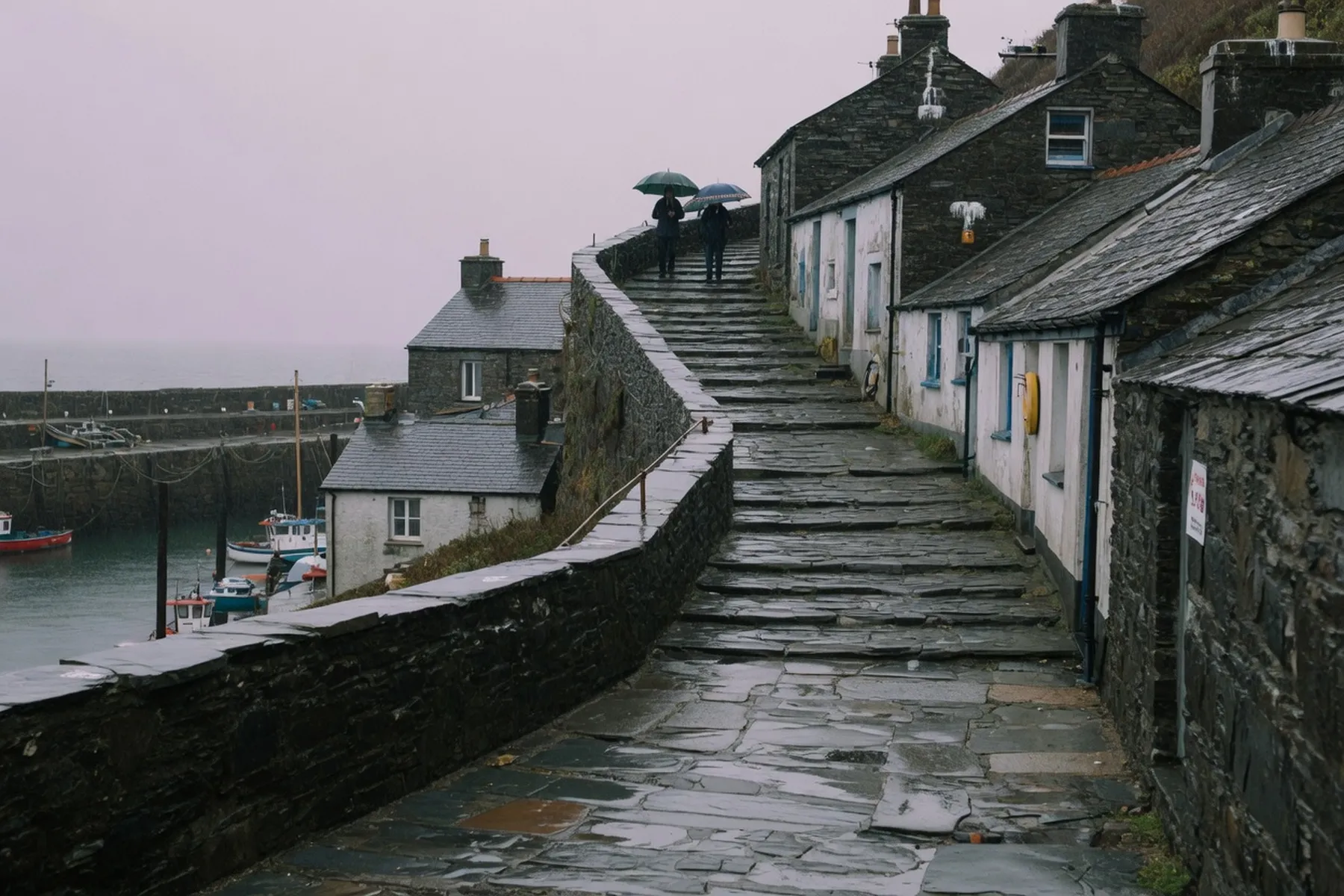
Tenby’s two indoor histories sit a few minutes’ walk apart inside the walled town. The National Trust’s 15th-century merchant townhouse is on Quay Hill; Tenby Museum & Art Gallery, founded in 1878, stands on Castle Hill above the harbour. Between them they hold an ordinary wet afternoon, and in autumn and winter — when a beach day is not guaranteed — they are the dependable fallback. Neither is a big site. The house runs as a timed guided tour; the museum is a compact wander through three permanent galleries and two temporary spaces, so the two pace each other well.
The National Trust’s own line is the best introduction: “Step into the world of a successful merchant and his family in 1500.” The house on Quay Hill was built around 1490–1500 and is Grade I listed, three storeys of a working townhouse rather than a great hall. It sits inside the town walls, a short climb from the harbour. Phone 01646 623110; address Quay Hill, Tenby SA70 7BX.
The ground floor is where the household worked. A merchant’s shop faces the street, and behind it a working kitchen keeps an open fireplace and a stone slate floor, with a door out to the garden. The small courtyard herb garden is open when the weather permits. Everything here is presented as a working home, not a roped-off interior.
Upstairs the house shows how the family lived. The first-floor hall carries colourful wall hangings and replica Tudor furniture. The second-floor bedchamber has a four-poster bed, a swinging crib and the garderobe tower. The swinging crib is the detail families remember, a reminder that this was a house with children in it rather than a museum piece. The upper floors are reached by steps over uneven surfaces; the ground floor alone is step-free, which matters if you move slowly or push a chair.
The house is not open every day, and the pattern changes with the season. From 24 September to 31 October 2026 it opens Thursday, Saturday and Tuesday, 11:00–16:00. Admission is £7.00 adult, £3.50 child (5–17), under-5s free, and £17.50 for a family of two adults and up to three children. Groups of over ten pay £6.65 per adult with a 5% discount; National Trust members go free. Visits are timed guided tours, and the Trust recommends booking in advance.
There is no on-site parking, no toilets and no food or drink, so plan around that before you set out. There is a shop and a second-hand bookshop, and large-print and Braille guides. Only assistance dogs are admitted. Read the National Trust’s visit page for the live hours.
From 27 November to 12 December 2026 the house runs Nadolig Tuduraidd, A Tudor Christmas, every Friday and Saturday, 11:00–15:00, last entry 2:30 pm. It is normal admission, no extra fee and no booking, with a small gift for children under ten while stocks last. It is the rare indoor event that needs no planning beyond turning up, so it slots into a wet December weekend easily. The organiser is the National Trust; check the page above before you travel, because those dates are the whole of the Christmas opening.
Tenby Museum & Art Gallery was founded in 1878 and still calls itself Wales’s oldest independent museum. It is a registered charity (No. 1169435), not a council or national body, so it keeps its own hours and its own ticket. The Grade II building on Castle Hill began as a National School and is adapted from medieval castle structures. Address: Castle Hill, Tenby SA70 7BP.
The art collection is the surprise for a small town. It holds Gwen John, Augustus John, Kyffin Williams, John Piper, David Jones, John Knapp Fisher, John Uzzell Edwards, Nicky Wire of the Manic Street Preachers, Graham Sutherland and Fiore de Henriquez. Augustus John was born in Tenby in 1878, and the collection includes his portrait sketch of T. E. Lawrence at the 1919 Paris Peace Conference, plus an early Tenby landscape by his sister Gwen. The collection reads like a roll call of Welsh art, and for a visitor caught by the rain it is the strongest room in the building.
The other two permanent galleries run from the deep past to the town itself. The prehistory gallery covers Precambrian rocks through to the Romano-British period and includes a fossil trilobite from Narberth. The Story of Tenby follows the town from the 9th century to the present through its sea connections, the fishing, the trade and the holiday resort the harbour made of it. Robert Recorde, born in Tenby, invented the equals sign and published it in The Whetstone of Witte. Look also for the Tenby Gun, a nine-foot 16th-century Tudor breech-loading cannon recovered from St Catherine’s Island. Hands-on interactives, quizzes, dressing up and a piracy area keep children busy.
From April to September the museum opens Monday to Friday, 10 am–4 pm, last entry 3:30 pm. From October to March the museum itself says hours are “to be confirmed” — there is no published winter timetable, so check tenbymuseum.org.uk before going rather than trusting an aggregator that still lists daily year-round opening.
Admission from Tuesday 7 April 2026 is £7 adult, £6 concession, and children under 13 free. Tickets are valid for 12 months. Concessions, with ID, cover OAPs, students, registered disabled people, armed forces, blue light workers and the unemployed; carers and wheelchair users are free. A Gift Aid scheme is offered at no extra charge, the gift shop is free to visit, and pre-booked groups get discounts. Dogs are not allowed except assistance dogs.
Because the winter hours are unpublished, autumn is the season to be careful with: a mid-week visit in November might find the doors shut if the museum has not yet posted its winter timetable. Phone the museum or read its plan-your-visit page the day before, and pair the house’s published Tudor Christmas Fridays and Saturdays with a museum visit only after checking the museum’s own page.
The two buildings are a few minutes’ walk apart across the old town, up from Quay Hill to Castle Hill. Castle Hill is steep but accessible, and the museum has a lift to every floor; there are three steps down to the disabled toilet and the temporary gallery, and a wheelchair is available free. Limited Blue Badge parking sits in the harbour area. The house, as above, is step-free only on the ground floor. Neither building has a café, so plan refreshments elsewhere in town.
Start with the house, because it is the one that needs booking and the one with the tighter, three-day opening pattern, then walk up to the museum for the untimed galleries and the 12-month ticket. If you are here on a wet weekend in mid-November, the Tenby Blues Festival runs 13–15 November 2026 — the 20th edition, around 50 acts across 20-plus venues — and the two buildings make a dry daytime option between sets; check tenbyblues.co.uk for the programme. Around the same weeks the town’s road race, Christmas market and Boxing Day Swim fill other autumn weekends, so check each organiser before planning around them. The Tenby in the Rain piece gathers the rest of the town’s wet-weather options, and the town walls walk puts both buildings back into the old town they belong to.
Neither building will fill a full day, and that is the point: together they occupy a late morning and a good part of an afternoon without rushing. If the rain clears, the harbour and Castle Hill are steps away, and the museum’s 12-month ticket means you can leave early and come back on another visit without paying again.