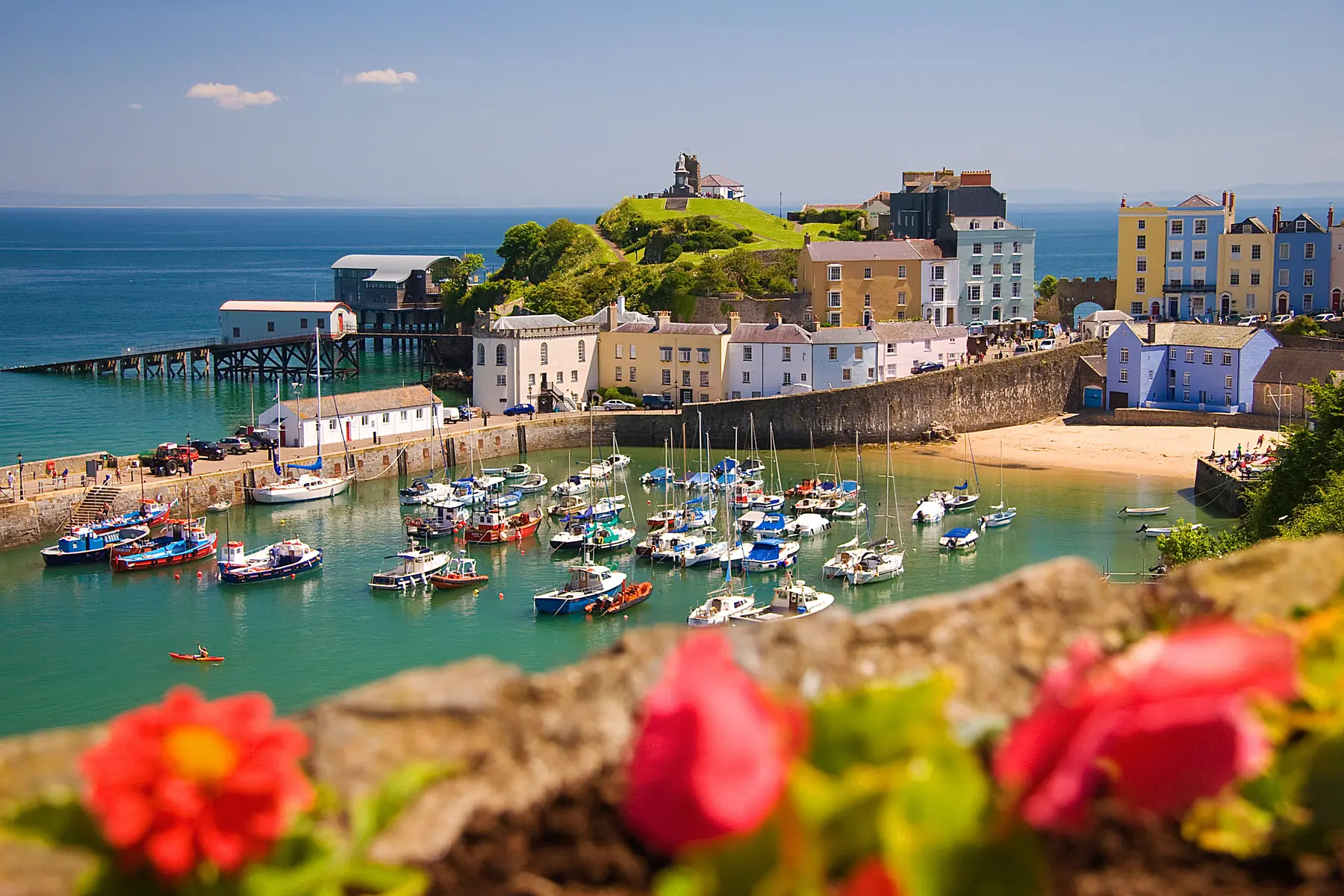
Tenby feeds a great many visitors and has been doing so since the Victorians arrived, so there is plenty of it — the old town is dense with cafés, restaurants and pubs, and the ratio of good to indifferent is better than in most resorts because the town has a year-round population and a long season.
The geography is compact. Tudor Square, High Street, St Julian’s Street, Upper Frog Street and the lanes down to Quay Hill hold almost everything, and the whole of it is inside the medieval walls.
Plantagenet House on Quay Hill is Tenby’s landmark restaurant — a medieval stone building with a Flemish chimney, a wood-burning stove in winter, and cooking that has kept its reputation for decades. It is the one to book.
Around it, the narrow lanes carry a good spread: seafood, Italian, Indian, Welsh cooking and a large number of cafés. The standard is high in the streets a little back from the harbour and more variable directly on it, which is the usual pattern in a resort.
Tenby’s Welsh name — Dinbych-y-Pysgod, the little town of fishes — tells you what it was for. The harbour still lands crab, lobster and mackerel in season, and several of the restaurants buy locally.
For the informal version, the harbour and the beaches have crab sandwiches and fish stalls in summer, and the mackerel fishing trips from the harbour will sell you what you catch, which children find deeply satisfying.
Saundersfoot next door and the East Neuk of Pembrokeshire — Angle, Stackpole and the Cleddau villages — are the wider seafood country.
Not a joke in Tenby. Fecci and Sons on Upper Frog Street has been making ice cream in the town for generations and is a genuine institution — Italian-Welsh, family run, and the queue on a summer afternoon runs down the street. There is a fish and chip shop of the same name.
Harbwr Brewery has a taproom and kitchen on St Julian’s Street, brewing in the town and serving food through the day. It is the best pub-and-brewery combination in south Pembrokeshire.
Beyond it, the old town has a good stock of pubs, several of them old and small, and Welsh brewing is well represented across the county.
Saundersfoot, four kilometres north, has a harbour and a run of restaurants and pubs, and is an easy evening out — there is a train, or the coast path.
Narberth, twenty kilometres north, is Pembrokeshire’s food town: delis, a bakery, an independent department store with a food hall, and several good restaurants. Just outside it, the Grove of Narberth is the county’s leading country house hotel with a serious kitchen.
Manorbier, Amroth and Lydstep have village pubs within ten kilometres, and Colby Woodland Garden at Amroth has a National Trust tearoom.
Laugharne, twenty kilometres east, has the Dylan Thomas connection and a couple of good places by the estuary.
Crab and lobster landed at the harbour. Welsh Black beef and salt marsh lamb from the estuaries. Laverbread, the seaweed preparation traditionally served with cockles and bacon — a Welsh breakfast thing, and worth trying once. Welsh cakes and bara brith. And Pembrokeshire early potatoes, which have protected status and a short, celebrated season in early summer.
Booking. Tenby is full in July and August and at half terms. Book dinner, particularly at Plantagenet House and the better harbour restaurants.
Cars are excluded from the historic centre in summer, which is a good thing for eating out and means you will be walking in from a car park.
Seasons. A number of places reduce hours or close from November to March, though Tenby has more year-round trade than smaller Pembrokeshire resorts.
Timing. The town fills at lunchtime with day visitors. Eating early or late makes a considerable difference in August.
Breakfast in one of the cafés in the walled town. Mid-morning coffee looking at the harbour from the Castle Hill side, which is the view everyone photographs. Lunch — crab sandwich or fish and chips — eaten on South Beach. Fecci’s ice cream in the afternoon, without argument. Dinner at Plantagenet House on Quay Hill, booked. And a last drink at the Harbwr taproom on St Julian’s Street.
The whole circuit is inside the medieval walls and takes about ten minutes to walk end to end.
Tenby’s population of under five thousand multiplies several times over in August, and the restaurant supply does not. Two habits fix most of it: book dinner in the morning rather than the evening, and eat outside the middle of the day, when the day-trip coaches are in.
Out of season the town is much quieter and a proportion of places close from November to March — though Tenby keeps more year-round trade than the smaller Pembrokeshire resorts, and a winter weekend in the walled town with the sea running is cheap and very good.
Reasonably well served for a traditional resort. The newer independents in the old town cater properly, the Indian and Italian restaurants have substantial meat-free menus, and the cafés have caught up. The seafood restaurants and the chip shops are, as ever, the weakest link.
Tenby sits in a county that produces unusually well, and the restaurants that bother to source locally say so. Crab and lobster are landed at the harbour and at Saundersfoot. Welsh Black beef and salt marsh lamb come off the Cleddau and Taf estuaries. Pembrokeshire early potatoes have protected status and a short, celebrated season in May and June. And the artisan food economy centred on Narberth, twenty kilometres north, supplies bakeries, cheesemakers and smokehouses across the county.
The practical advice is to look at the menus rather than the frontages. In a resort town the places with the best views are not always the ones buying from the boats, and the good kitchens here are usually a lane back from the water.
If you are walking, the useful fixed points are Saundersfoot five kilometres north, Amroth seven kilometres north-east, Penally just south, and Manorbier seven kilometres south-west. Between Manorbier and Freshwater East there is very little, and the stretch beyond Lydstep has nothing at all.
The Colby Woodland Garden tearoom at Amroth and the beach cafés at Saundersfoot are the reliable stops on the northern half.
Plantagenet House on Quay Hill, in a medieval building with a Flemish chimney. Book ahead.
Fecci and Sons on Upper Frog Street, a family institution in the town for generations.
Harbwr Brewery, with a taproom and kitchen on St Julian’s Street, brewing in the town.
Saundersfoot for the harbour, or Narberth twenty kilometres north, which is Pembrokeshire’s food town.
Yes — the mackerel fishing trips from the harbour are cheap, short and reliably successful.